
If the usual beach trips or staycations feel a bit repetitive this year, there is one island province that transforms the Passion of Christ into a living, breathing drama. While the long break often signals a time to unwind, Marinduque offers a different kind of energy.
The province is synonymous with the Moryonan, but the tradition feels most vibrant in the municipality of Santa Cruz. While the entire island wears the mask, Santa Cruz has a way of making the celebration feel more colorful and deeply personal. At the center of this spectacle is a man named Longinus. He is the Roman soldier who effectively “main-charactered” his way out of a minor biblical cameo and into a centuries-old mystery that remains a cornerstone of local culture.
The Captain and His Men
In the Marinduque imaginary, Longinus is the Captain of the Roman centurions, the high-ranking officer tasked with the most sensitive assignments in Jerusalem. Following apocryphal lore, local tradition designates him as overseeing the crucifixion of Christ, ensuring the prisoner was dead with his spear, and was later assigned to keep watch over the sealed burial cave.
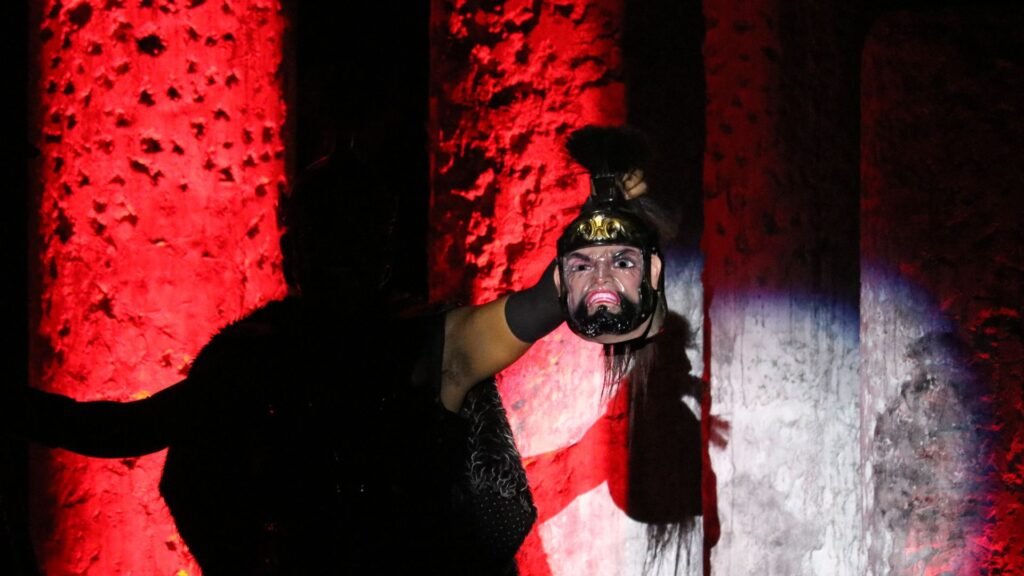
So when you see hundreds of masked figures marching through the streets of Marinduque, you are not looking at hundreds of “Longinuses.” Instead, the majority of the Moriones depict the rank-and-file soldiers of his unit – the men under his command. They wear the scowling, bearded masks of the Roman legion, representing the force that guarded the tomb and eventually witnessed the resurrection alongside their captain.
Longinus’s mask stands apart from them, often identified by a blind eye that captures his moment of transformation.
The Spear That Got a Name
In the Gospel of John, the figure is merely an anonymous soldier. He performs a grim task, stabbing the side of Jesus to confirm the execution is over, and then vanishes from the text. He is given no name and no specific rank in the official biblical record.
The name “Longinus” actually surfaced later in apocryphal—or unofficial—texts, specifically the Gospel of Nicodemus from the 4th century. The writers essentially took the Greek word for spear, longche, and personified it. It is the historical equivalent of naming a legendary driver “Mr. Sedan,” yet the name stuck so firmly that he eventually became a recognized saint in several Christian traditions.
The Original 4K Glow-Up
The most enduring part of the legend involves a physical healing. Ancient accounts suggest that Longinus suffered from failing eyesight, with some versions citing cataracts or near-blindness. The story goes that when he pierced Christ’s side, a drop of blood and water splashed directly into his eyes.
Suddenly, his vision snapped into perfect clarity. This was not just a medical recovery; it was a total shift in how he perceived his surroundings. Dropping his weapon and witnessing the earthquake and the darkened sky, he realized the gravity of his actions. His famous declaration, “Truly, this was the Son of God,” represents the ultimate moment of realization for a man who had spent his life in the dark.
The Career Change
Longinus did not simply return to the barracks. After witnessing the resurrection—an event the authorities desperately wanted to keep quiet—he reportedly abandoned the Roman army entirely. He moved to Cappadocia, in what is now Turkey, to begin a new life.
However, the Roman Empire rarely looked kindly on desertion or whistleblowing. His former comrades were eventually sent to track him down. In a move that mirrors a high-stakes period drama, Longinus reportedly welcomed the soldiers into his home and shared a meal with them before revealing his identity. He was eventually beheaded, a sacrifice that is now commemorated through the dramatic “Pugutan” ceremony held during the festival.
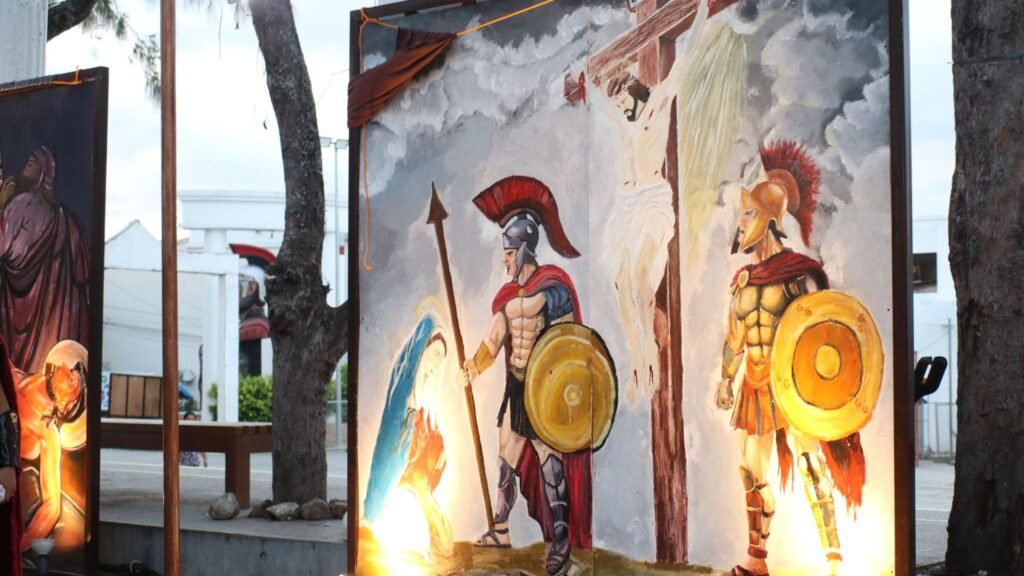
In the Philippines, Longinus is far more than a figure in a European museum. He is the heart of the Moryonan in Santa Cruz.
The masks seen throughout the town, characterized by wide, unblinking eyes, capture that exact second of his healing—the shock of a man finally seeing the truth. The “Chase” through the winding streets is not just a parade; it is a reenactment of the Roman hunt for a captain who turned his back on an empire to follow his conscience.
Longinus stands as the patron saint of the second chance. His story serves as a reminder that even a figure who starts as the “villain” can change the ending of their own narrative. For those heading to Marinduque this Holy Week, a stop in Santa Cruz offers a chance to see this ancient legend come to life in the most colorful way possible.